
Screenshot
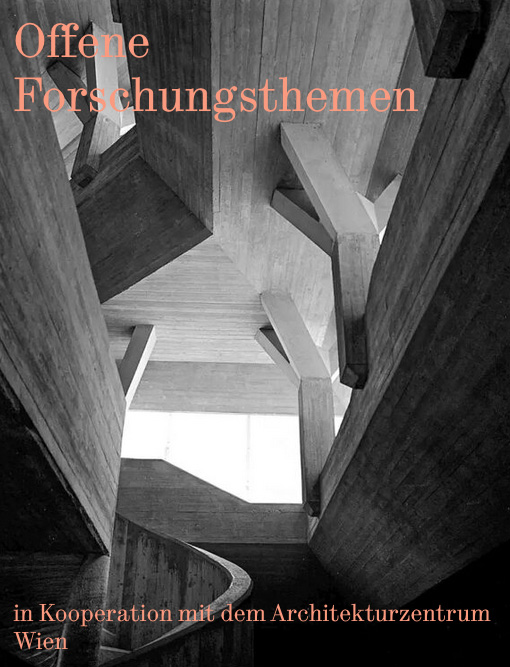
© Foto: Karin Mack
The Architekturzentrum Wien Collection and History of Art Research at TU Wien are cooperating, and provide research topics for theses and dissertations.
The Az W’s extensive collection on Austrian architecture of the 20th and 21st centuries contains unique primary source material and exponents. These are being carefully catalogued, researched and disseminated in various ways.
Together with History of Art Research at TU Wien, the goal is to achieve research synergies at the Az W Collection Research Center that combine teaching, research and communication:
- Qualified analysis of primary sources and objects from the Az W Collection
- Interdisciplinary courses and hands-on experience of research for students
- Joint communication formats to raise awareness of Austrian architectural history
Research Topics
Beyond the Familiar Works: The Housing Megastructures in the Architectural Legacy of Roland Rainer
Roland Rainer (1910–2004) was an Austrian architect who significantly impacted the architecture of the 20th century in Austria with buildings such as the Vienna City Hall (1958), the Puchenau housing estate near Linz (1965–2000) and the ORF Centre in Vienna (1968–1974). His concept for compact low-rise construction — which he formulated together with Johannes Göderitz and Hubert Hoffmann in the book “Die gegliederte und aufgelockerte Stadt” (the structured and dispersed city, 1957) — was long regarded as a standard work of post-war urban planning. From the 1970s onwards, Rainer began to participate in competitions for residential “megastructures”. These included projects for the democratic Federal Republic of Germany, such as a city for 100,000 inhabitants in Munich/Perlach, or housing for the socialist government of the City of Bratislava. Rainer’s architectural estate was acquired by the Az W collection in 2015. The aim of the theoretical dissertation is to document and analyse the typology of the large-scale residential developments, a typology that has received little attention in Rainer’s oeuvre to date — and it needs to be examined in the context of his urban development concepts.
Architecture in Focus: Karin Mack’s Role as a Visual Chronicler
Karin Mack (born 1940) is an Austrian photographic artist whose work constitutes a significant contribution to the feminist avant-garde in Austria. While she is best known for her innovative work in the field of feminist photography, her photographs documenting architecture in the late 1960s and 1970s are not so well anchored in the minds of the public. Many of her photographs feature in Friedrich Achleitner’s guides to 20th-century Austrian architecture, making Karin Mack an important chronicler of Austrian architectural history. Mack’s archive of architecture photographs has been part of the Az W collection since 2013. These holdings provide a valuable basis for a theoretical dissertation analysing Mack’s architectural photography for the first time. The aim is to gain an overview of Mack’s oeuvre and, with the support of a supervisor, to develop a subject for the dissertation from the archive holdings.
Transparent insights: Günther Feuerstein in the Context of Theoretical Discourse on Architecture
Günther Feuerstein (1925–2021) was an Austrian architect who, from 1970 onwards, published the magazine Transparent, which was designed and layouted with the support of students from Vienna University of Technology. It featured presentations of international trends in architecture as well as discussions of current local issues. The focus was on a strong theoretical approach to architecture. Parallel to this, Feuerstein organised Club Seminars, which were among the most important discussion groups of the time. Current developments were discussed there regularly with a small circle of students from Vienna University of Technology. In Feuerstein’s obituary, the Vienna University of Technology wrote that, “He was a charismatic mediator who distinguished himself among the faculty at TU Vienna in the context of the 1968 student movement as a leading theoretical mind.” Feuerstein’s archives have been in the Az W Collection since 2017, providing appropriate subject matter for a theoretical dissertation. Part of the task is to compile and catalogue these holdings in an initial inventory. A specific topic is then to be identified with this overview in consultation with the supervisor.
Design for All: The Archives of the Institut für Soziales Design as a Source for Research
“The guiding principle behind Social design is to put people first in the endeavour to shaping products, objects, living and working spaces around users’ needs.” The Institut für Soziales Design was founded in 1975 on the initiative of five designers: Dieter Berdel (1939), Herbert Hammerschmied (1946–1983), Hans Hovorka (1946–2002), Peter Pruner (1945) and Josef Seiter (1950), who adopted a critical approach to design education and practice. The aim of their design was to focus on users’ needs. The first projects and exhibitions were planned and initiatives were launched to establish standards for disabled-friendly and elderly-friendly planning and construction by working in collaboration with disability organisations and experts from the fields of social work, occupational therapy and rehabilitation medicine. The idea was also influenced by trends in Scandinavia and by the writings and work of Austrian-born designer Victor Papanek. The archives of the Institut für Soziales Design have been part of the Az W Collection since 2025, and provide appropriate subject matter for a theoretical dissertation. As part of the task, a rough inventory of the contents of the archives is to be compiled. With this overview, a specific topic can then be identified in consultation with the supervisor.