
Ottokar Uhl, view of the pyramid-shaped church, Naedangdong, Daegu, KR, 1964-1966
© Photograph: Architekturzentrum Wien, Collection
"On a scale of grades from A to D, I would rate it as follows: A for urban planning, A for exterior space, A for interior space and A for liturgy." Ottokar Uhl in a letter to his co-workers about the church in Daegu
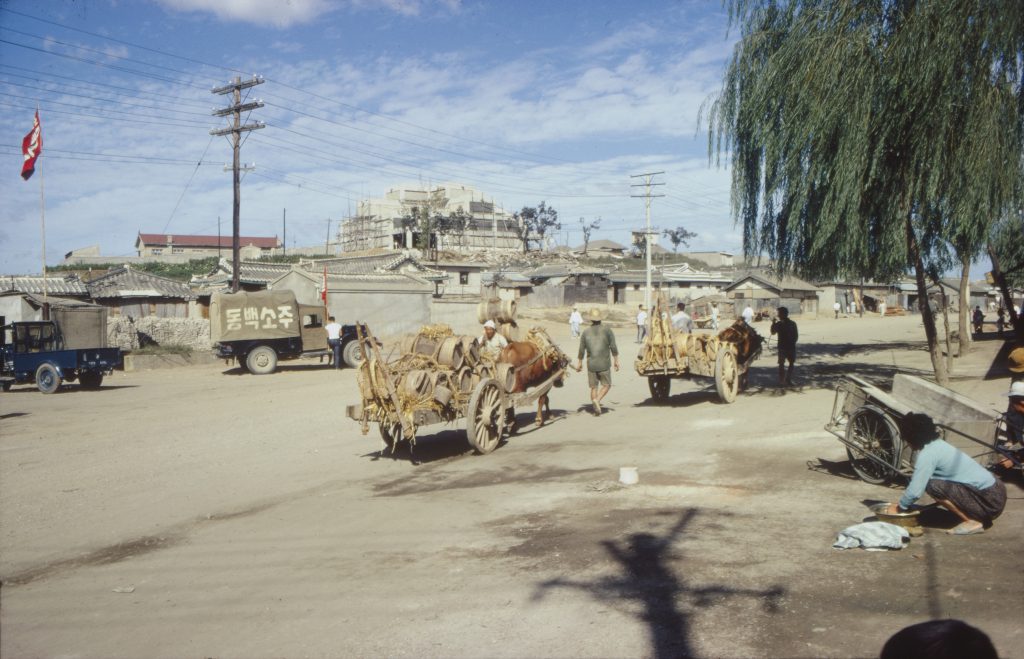
When the church in Naedangdong, Daegu (South Korea), opened in 1966 it formed a sharp contrast to its surroundings: flat huts, people in traditional dress and animals in a rural setting. In contrast, with a floor plan of 25 x 25 metres, Ottokar Uhl’s building rises on a hilltop like a stepped pyramid. The central element is the light that enters exclusively from above through ceiling openings of varying heights. The stacked reinforced concrete cuboids with infilled walls of clinker bricks appear very monumental in contemporary photographs. Today, the church is surrounded completely by other buildings.
In the 1960s, Naedangdong was a socially deprived neighbourhood with mission stations for leprosy patients and a high crime rate. The initial spark for the project was a visit to Vienna by Archbishop Sye Bong-Kil from Daegu. Austrian priest Rudolf Kranewitter, who led a parish in South Korea, played an important role in the Catholic network between Austria and South Korea. The original proposal, which also included a pastoral care centre, was scaled back for financial reasons. It received significant support from the Sternsingeraktion (carol singing campaign) of the Austrian Catholic Youth Association. Despite having been intended as a model for future churches in South Korea, Uhl’s building remained unique as a structure.
Ottokar Uhl (1931-2011), a graduate of Lois Welzenbacher’s master class at the Academy of Fine Arts in Vienna, attended Konrad Wachsmann’s legendary summer seminar in Salzburg in 1957, which facilitated access to industrial prefabrication for many Austrian architects. Uhl became known for innovative church buildings that reflect the liturgical reforms following the Second Vatican Council. In addition to the church in Daegu, in the 1960s alone he designed 37 churches and chapels in Austria with the focus on materials and construction: “If you separate everything that cannot be expressed by technical means from the task of building a church, what remains is the profane task… of constructing a hall with a large span.”
The construction of the church in Daegu was a complex task due to the great distance from Austria and differences in building standards and materials. Uhl visited the construction site three times, although he never saw the finished building. In 1988, the church underwent extensive interior alterations with the installation of a ceiling and various room partitions, while it remains an important testimony to Uhl’s architectural vision and the liturgical movement after 1960.