1863
Founding of the Österreichisches Museum für Kunst und Industrie (Austrian Museum of Art and Industry, commonly referred to simply as the Austrian Museum) on the initiative of Rudolf von Eitelberger.
1866–1871
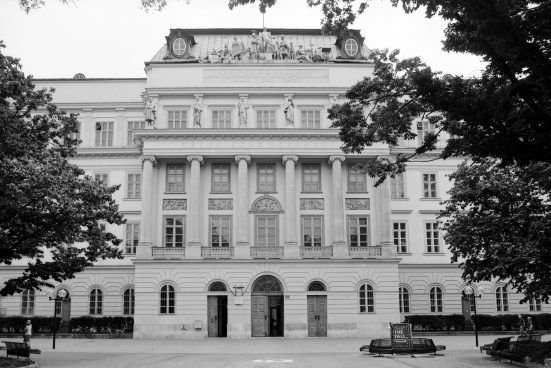
Construction of the Austrian Museum of Art and Industry at Stubenring 5, Vienna 1, according to the plans of Heinrich Ferstel.
1867
Foundation of the k. k. Kunstgewerbeschule des k. k. Österreichischen Museums für Kunst und Industrie (Imperial and Royal School of Applied Arts of the Imperial and Royal Austrian Museum of Art and Industry).
1868
Opening of the School of Applied Arts in the Gewehrfabrik (rifle factory), Währinger Straße 11–13, Vienna 9. It essentially follows the model of the South Kensington Museum in London.
There is a consistent separation—both spatially and institutionally—of artistic and applied arts training. Architecture has been a core subject of the School of Applied Arts from the very beginning.
For students of all disciplines, three years of preparatory school (later the General Department) are required, followed by specialized classes or workshops. Additional courses are also mandatory. While initially the curricula are quite individually tailored for each student, over time, increasingly strict regulations are introduced. Students with sufficient prior knowledge can be exempted from parts of the prescribed curriculum.
The first faculty is assembled to represent a balanced mix of academic artists and practitioners of applied arts. Josef Storck, Ferdinand Laufberger, Friedrich Sturm, Otto König, and Michael Rieser are appointed professors of the School of Applied Arts upon the recommendation of the supervisory board; a permanent directorship is not established; Josef Storck, head of the School of Architecture, become the institute’s first director for a period of two years.
1875–1877
Construction of the School of Applied Arts at Stubenring 3, Vienna 1, according to the plans of Heinrich Ferstel.
1906–1908
Museum extension at Weiskirchnerstraße 3 by Ludwig Baumann.
1919
Renamed Kunstgewerbeschule des österreichischen Museums für Kunst und Industrie (School of Applied Arts of the Austrian Museum of Art and Industry).
1921
The School of Applied Arts of the Austrian Museuym of Art and Industry is designated a Federal Educational Institution.
1931
The School of Applied Arts of the Austrian Museum of Art and Industry is designated a Federal Institution.
1937
Renamed Staatliche Kunstgewerbeschule Wien (State School of Applied Arts Vienna).
1941
Renamed Reichshochschule für angewandte Kunst Wien (Reich University of Applied Arts Vienna).
1945
Renamed Hochschule für angewandte Kunst Wien (University of Applied Arts Vienna).
1948
Renamed Akademie für angewandte Kunst Wien (Academy of Applied Arts Vienna).
1962–1965
Extension of the Academy of Applied Arts by Karl Schwanzer.
1971
Renamed Hochschule für angewandte Kunst Wien (University of Applied Arts Vienna).
1998
On October 1st, the Hochschule für angewandte Kunst Wien becomes the Universität für angewandte Kunst Wien (University of Applied Arts Vienna); adaptation to the new organizational law (KUOG).
Literature
Rudolf Eitelberger, Oesterreichische Kunst-Institute und Kunstgewerbliche Zeitfragen, II. Band Gesammelte Kunsthistorische Schriften von R. Eitelberger v. Edelberg (Vienna: Braumüller, 1879).
Gottfried Fliedl, Kunst und Lehre am Beginn der Moderne. Die Wiener Kunstgewerbeschule 1867–1918 (Salzburg and Vienna: Residenz Verlag, 1986).
Otto Kapfinger/Matthias Boeckl, Abgelehnt: Nicht ausgeführt. Die Bau- und Projektgeschichte der Hochschule für angewandte Kunst in Wien 1873–1993 (Vienna: Universität für angewandte Kunst, 1993).
Egon Loebenstein (ed.), 100 Jahre Unterrichtsministerium 1848–1948. Festschrift des Bundesministeriums für Unterricht in Wien (Vienna: Österreichischer Bundesverlag, 1948).
Elfriede Nebel, Die kunstpädagogischen Ideen, Theorien und Leistungen Rudolf von Eitelbergers. (PhD diss., University of Vienna, 1980).
Peter Noever (ed.), Kunst und Industrie. Die Anfänge des Museums für Angewandte Kunst in Wien, exhibition catalogue (Vienna and Ostfildern-Ruit: Hatje Cantz Verlag, 2000).
Author: Barbara Sauer