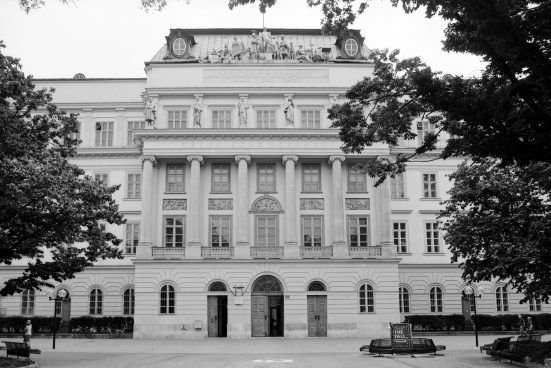
1846
Opening of a Gewerbliche Zeichenschule (Commercial Drawing School) with four departments:
- Preparatory School for Small Trades
- Drawing School for the Construction Industry
- School for Manufacturing Drawing
- Drawing School for Mechanics
Instruction in two groups: Sunday classes and weekday classes; subordinate to the Polytechnic Institute.
1865
The Commercial Drawing School is separated from the Polytechnic Institute and placed under the authority of architect Wilhelm Westmann. The school is located in the former Sigl locomotive factory on Währinger Straße, Vienna 9.
1867
The technical disciplines are removed from the curriculum of the Realschulen (secondary schools). This creates the need for a Higher Technical College.
1868
Architect Westmann is commissioned to develop the concept for a day school providing theoretical and vocational education.
The school moves to the Gusshaus in Wieden, Vienna 4.
1870
The Commercial Drawing School is renamed the K. k. Bau- und Maschinengewerbeschule (Imperial and Royal School of Construction and Mechanical Engineering)—the first trade secondary school in Austria and the precursor to the later state trade schools. Part of the school moves to the St.-Anna-Gebäude, Annagasse 3, Vienna 1 (previously home to the painting school of the Academy of Fine Arts).
1880
Renamed K. k. Staats-Gewerbeschule (Imperial and Royal State Trade School).
1880/81
First class. The Imperial and Royal State Trade School is comprised of four different branches:
- Higher Trade School: a department for construction, a department for mechanical engineering (4 years)
- Master Craftsman School with a construction department (closed in 1910/11) and a mechanical engineering department (closed in 1889/90) (2 years)
- Special courses for boiler operators, locomotive drivers, etc.
- Commercial Drawing School (closed in 1904/05)
Partly housed in the St.-Anna-Gebäude, Annagasse 3, Vienna 1, partly in the Gußhaus (Gußhausstraße/Favoritenstraße, Vienna 4).
After completing the Master Craftsman School, students who passed the master builder’s examination are permitted to use the title Architekt (Architect).
The school could also be completed without a school leaving examination, with a certificate of attendance. (The school leaving examination was less important for professional application than for administrative matters—especially the right to one year of voluntary military service. How long this provision remained in effect is unknown.)
1883
Camillo Sitte becomes director; new school building erected at Schellinggasse 13, Vienna 1 (designed by Dominik Avanzo and Paul Lange).
The students’ ages range from 13 to 36.
1897
Reform: Introduction of workshop-based instruction, field trips, stricter admission requirements: 4 years of middle school or secondary school, or 8 years of elementary school, are prerequisites.
1909/10
Reform: New curriculum. Schooling extended to 4 ½ years (9 semesters). Practical experience on a construction site is required in the 6th semester.
1910/11
The Master Craftsman School is replaced by the Bauhandwerkerschule (Construction Trades School) for journeymen who have completed apprenticeships in masonry or carpentry: three courses of five months each.
Admission required completion of the third year of a general vocational school or the second year of a specialized Construction Trades Continuation School. The minimum age was 17, and an apprenticeship in the relevant trade was required.
1912
Establishment of a training workshop (school construction yard) at Lebergasse 4, Vienna 3. The Construction Trades School is relocated to Lebergasse.
1914
The school building on Schellinggasse becomes a reserve hospital – relocation to Eugenstraße 81 (today Pernerstorfergasse), Vienna 10. Instruction is limited to the higher grades. After the war, supplementary courses are offered for students who interrupted their studies due to military service.
1918
Return to Schellinggasse; war damage is repaired.
1922/23
New name: Technisch-gewerbliche Bundeslehranstalt (Federal Technical and Vocational Training Institute).
The higher departments for mechanical engineering, structural engineering, and civil engineering are established.
1939
Introduction of the engineer title for graduates of the state engineering schools and the state building school. An engineering certificate is issued after the final examination.
1946
“Ischl Conference”: Development of new curricula, modernization of the school’s construction yard, reorganization of the Building Trade School:
Higher Department for Structural Engineering – 5 years, culminating in the final examination; the engineering title is awarded after 4 years of practical experience.
Building Trade School – 3 years, for learning the building trades.
The first class is taught jointly, followed by selection.
In addition, there is a building trade school for bricklayers and carpenters with three semester courses.
1963
New name: Höhere technische Bundeslehr- und Versuchsanstalt Wien 1 (Higher Federal Technical College and Research Institute Vienna 1).
1982
Separation of the civil engineering and mechanical engineering departments.
The mechanical engineering departments relocate to the HTL Ottakring, Thaliastraße 125.
The civil engineering departments relocate to Leberstraße 4c in Vienna 3. The building is newly constructed, incorporating the existing structure (1980–1987 by Manfred Nehrer and Reinhard Medek).
New name: Höhere technische Bundeslehr- und Versuchsanstalt (Camillo Sitte Lehranstalt), Wien 3 (Higher Federal Technical College and Research Institute [Camillo Sitte Technical College for Construction Engineering], Vienna 3).
Literature/Sources
Jahresbericht der k. k. Bau- und Maschinen-Gewerbeschule
Jahresbericht der k. k. Staatsgewerbeschule und der damit verbundenen gewerblichen Fortbildungsschule in Wien
Festschrift zur 50 Jahrfeier der Technisch-gewerblichen Bundeslehranstalt Wien 1, 1880–1930
Festschrift Bundesgewerbeschule in Wien 1, 1880–1955
90 Jahre Schellinggasse, Festschrift der HTL Wien 1. (no information on teachers and graduates)
100 Jahre Schellinggasse, Festschrift, Höhere Technische Bundeslehr- und Versuchsanstalt, 1880–1980. (no information on teachers and graduates)
Autorin: Inge Scheidl