
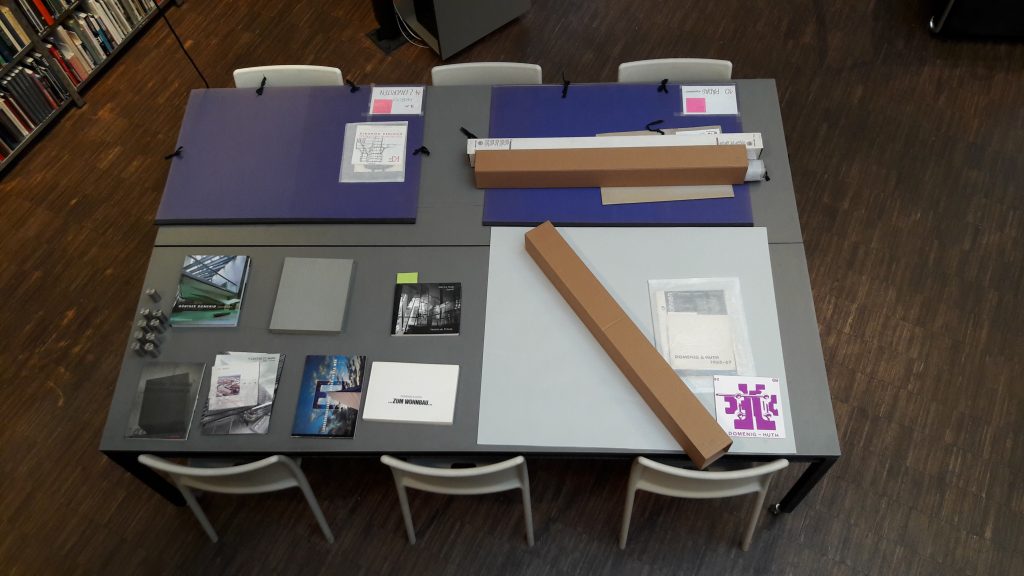
Material awaiting inspection
© Architekturzentrum Wien
2021-2024 Ambivalences of Modernity. The Architect and City Planner Roland Rainer between Dictatorship and Democracy. FWF (P 34938-G) January
Roland Rainer was one of the best-known architects and urban planners of post-war modernism in Austria. The Stadthalle in Vienna (1958), the Puchenau housing estate near Linz (1965-2000) and the ORF Centre in Vienna (1968-1974) are among his buildings. It is less well known that he went to Berlin as early as 1936, two years before Austria’s “Anschluss” to the National Socialist German Reich in 1938, and placed himself in the service of the German Academy for Urban Development, Reich and Regional Planning (DASRL), which was practically and theoretically subordinate to Albert Speer, the General Building Inspector for the Reich capital. Consequently, he was integrated into the National Socialist system not only through his early membership in the NSDAP, but also through his practice, hardly just through opportunism. In fact, he already developed his central theories on urban planning and architecture in the early 1940s at the DASRL. During this period, he conceived and wrote, together with his colleagues Johannes Göderitz and Hubert Hofmann, the first version of Die gegliederte und aufgelockerte Stadt, which was published in 1945 and became a standard work in German-speaking countries in its second version of 1957.
This writing contains something typical for its time: it criticises the modern, densely populated city, it pleads for a garden city model in which living, working, traffic and leisure are disentangled and people live “at ground level”. Only in the first version is this living “folk-biologically” propagated as the right way of living. Racist dictions like this are no longer found in the second version of 1957. But has the concept changed significantly as a result?
The research project, a collaboration between the Academy of Fine Arts Vienna (where Rainer taught as a professor) and the Architekturzentrum Wien (where Rainer’s estate is located), will be dedicated to investigating this question in two ways. On the one hand, Rainer’s historical development as a modernist architect will be examined in more detail for the first time; this includes his time as a student at the Vienna University of Technology in the 1920s. On the other hand, a current reassessment of the “ambivalence of architectural modernism” itself will be possible via Rainer’s concrete biography. Especially in the context of recent research on colonialism and racism in modern architecture, the question of the inherent biopolitics of garden city models can become substantial with the analysis of Rainer’s work. To this end, the “articulated and loosened city” as described by Rainer will be sketched for the first time and compared with other urban planning models. In addition, the complete estate will be reviewed and evaluated, and further material on Rainer will be excavated and analysed in archives in Germany, Poland and the Czech Republic. In this way, Rainer’s work is placed in a differentiated and well-founded context.
Prof. Dr. Angelika Schnell, Akademie der bildenden Künste Wien (Principal Investigator)
Dr. Ingrid Holzschuh, Dipl.-Ing. Waltraud P. Indrist, Akademie der bildenden Künste Wien (Postdoc Associates)
Mag. Susanne Rick, (Praedoc Associate)
Dr. Monika Platzer, Architekturzentrum Wien, (National Research Partner)
The metadata generated in the project from archival research is publicly accessible in the repository of the Academy of Fine Arts Vienna and can be accessed via the following link: Roland Rainer-Database. Metadata
2024 Course: Creating Landscapes – Margherita Spiluttini & Heinz Tesar
In the winter semester of 2024, a seminar entitled “On Display” was held with students from the University of Applied Arts Vienna and the Vienna University of Technology. The course focused on two components of the Vienna Architecture Center’s collection and culminated in an exhibition (March 9–12, 2024) at the University of Applied Arts Vienna, FLUX 1, Vordere Zollamtsstraße 7, 1030 Vienna. The exhibition examined how the individual perspectives and working methods of architectural photographer Margherita Spiluttini (1947–2023) and architect Heinz Tesar (1939–2024) contribute to the conception of landscape.
Project coordination Az W: Monika Platzer and Iris Ranzinger
2018–2024 Research:Architekturführer Niederösterreich (architecture guidebook of Lower Austria ) Study and appraisal of the Lower Austrian index cards by Friedrich Achleitner, and their supplementation to compile an extensive architecture guide of Lower Austria.
A cooperation between the Architekturzentrum Wien and Vienna University of Technology
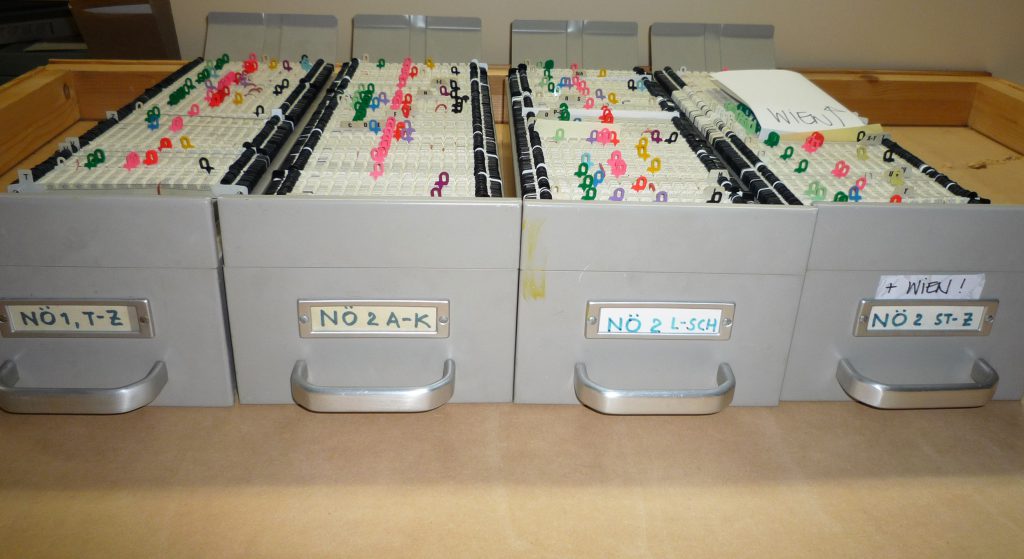
Over 40 years ago Friedrich Achleitner began his ambitious project to make a compilation of Austrian architecture in the 20th century, which was intended to be published in four volumes. He covered thousands of kilometres in its making, took thousands of photographs and wrote his own characteristic texts. His innumerable trips to the original locations have ultimately led to the several volumes of his famous Architekturführer, only the largest federal province of Austria remained unfinished, Lower Austria.
On the initiative of the former Director of the Az W Dietmar Steiner, in 2018 a research project was launched with the goal of publishing an architecture guide to Lower Austria. The book, although inspired by the volumes already in print, was not intended to copy them as neither Achleitner’s working approach nor his writing style should be subjected to imitation with a third visit to the objects concerned.
From January to September 2019, in an intense collaboration with students of Vienna University of Technology, Dietmar Steiner and Margarete Cufer, the 3,758 hand-written index card entries by Friedrich Achleitner, Dietmar Steiner, Margarethe Cufer and Margarethe Heuberger-Sentobe were completely digitised and transferred to the Az W digital database. The 875 strips of negatives with 5,250 individual black and white images of the objects documented by Achleitner have now also been digitised, identified and added to the index card entries.
At the same time, a digital database with the 764 objects from the ORTE Architekturnetzwerk NÖ and the Führer St. Pölten guides to the relevant architectural landscape has been recently updated and extended by Otto Kapfinger. Subsequent steps are also already making progress: the first short films on the key participants in the planning processes, such as Franz Fehringer and Norbert Steiner, are in production.
Az W project team: Ingrid Holzschuh, Monika Platzer
The project is supported by: FORUM MORGEN.
2020–2023 Research
Communities of Tacit Knowledge: Architecture and its Ways of Knowing
‘TACK / Communities of Tacit Knowledge: Architecture and its Ways of Knowing’ is a newly funded Innovative Training Network, as part of the Marie Sklodowska-Curie Actions within the European Framework Program Horizon 2020. It trains young researchers in understanding the specific knowledge that architects use when designing buildings and cities. TACK gathers ten major academic institutions, three leading cultural architectural institutions as well as nine distinguished architecture design offices. Collaboratively these partners offer an innovative PhD training program on the nature of tacit knowledge in architecture, resulting in ten parallel PhD projects.
Design projects commonly emerge from collaborations between designers, makers (builders, crafts(wo)men etc.), clients and a variety of experts, including social scientists, commercial, economic or technical advisors, critics and heritage consultants. This extended design team is thus composed of individuals with various backgrounds, different professional assumptions and varying perspectives of expertise. Architecture operates at the intersection of knowledge domains (arts, humanities, social sciences, applied technology) and has the capacity to create new solutions and perspectives based on its inherently synergetic knowledge production. So, architectural designs are the result of complex and occasionally conflicting sets of requirements that can only be reconciled through processes of negotiation between different disciplines and different fields of knowledge. These negotiations imply forms of synergetic thinking, which often rely on implicit common understandings, or tacit knowledge.
Tacit knowledge may be embedded in the relations between people, and is specific to particular historical developments and traditions. Tacit knowledge often results from the personal experience of making and thinking and therefore connects intellectual and practical work. It produces knowledge that is embedded in a community. As tacit knowledge is an essential element of the heuristic methods of knowledge production in the field of design it also contains a significant potential of absorbing and responding to change. Tacit knowledge offers designers highly relevant instruments for dealing with constantly fluctuating conditions and a set of complex and apparently contradictory requirements.
Further information: TACK
Academic partners:
ETH Zürich, Delft University of Technology, KTH Royal Institute of Technology, Oslo School of Architecture and Design, Bergische Universität Wuppertal, Politecnico di Milano, Academy of Fine Arts Vienna, University of Antwerp, University College London, Leibniz Universität Hannover
Non-Academic Partners:
Architekturzentrum Wien, Het Nieuwe Instituut, Flanders Architecture Insitute, architecten de vylder vinck taillieu, Korteknie Stuhlmacher Architecten, Spridd, De Smet Vermeulen architecten, Cityfoerster, One Fine Day architects, SOMA Architecture, Onsite studio, Snøhetta
2019–2023 Research: Transnational School Construction
The Architekturzentrum Wien is cooperation partner of the FWF research project Transnational School Construction (Grant Number P 33248).
The research project investigates transnational knowledge exchange in the field of school construction between Austria, Slovenia and the GDR after 1945. In the period after World War II, a profound change in the school system is emerging. This later so-called “awakening to the educational society” was accompanied by a new conception of school buildings. Instead of large, self-contained, multi-story school buildings, low, pavilion-like school buildings were erected amid green spaces.
In 1951, the School Building Commission was established within the Union Internationale des Architectes (UIA), which focused on the international exchange on design and technical solutions for school buildings. Through comparative studies in the global North and South, overarching principles for school construction and design were established and communicated by the Commission’s delegates in their respective national contexts. The research project examines the functioning of the UIA School Construction Commission to gain insights into the collaboratively organized production of school space. Focusing on the three UIA member states Austria, the German Democratic Republic, and Slovenia (part of Yugoslavia in the post-war period), the main construction methods and the processes of standardization and norming as well as the central actors in the respective countries and their exchange among each other are analyzed.
Dr. Maja Lorbek, University of Applied Arts Vienna (Project Leader)
Dr. Oliver Sukrow, TU Wien (National Research Partner)
Dr. Monika Platzer, Architekturzentrum Wien (Institutional Partner)
Mag. Susanne Rick, Architekturzentrum Wien (Researcher)
Project partner:
Architekturzentrum Wien (Az W)
Leibniz Institute for the History and Culture of Eastern Europe (GWZO)
University Kassel – Architecture Urban Planning Landscape Planning
University of Ljubljana – Faculty of Architecture
2019–2021 Research: Reframing Postwar Architecture in Austria — West Germany — Switzerland, 1945–1968
The aim of this international research project is to undertake an interdisciplinary recontextualisation of the narrative of the postwar architectural history in the three countries with regard to the global issues of the time.
In Austria and Germany the architecture of the postwar years was encountered with scepticism in many places. This position of rejection is not only founded in the moral implications of the politics of the era of rebuilding, but also in a modernity misunderstood as technology led mass production. There was a close relationship to Switzerland due to the geographic proximity, the shared language, the residency of Austrian and German groups of resistance during the war years and the long years of connection between international interest groups like the Werkbund and the CIAM (Congrès Internationaux d’Architecture Moderne), onto which could have been built directly after 1945. The Swiss colleagues as well as their specialist media created a door to the rest of the world for the two neighbouring countries. At the same time, the three countries shared that they were searching for a new cultural/political identity that led to a national reorientation under the direction of the Allies. The ‘perpetrator nation’ Germany sought a radical break with its Nazi past, Austria’s claim to ‘victim status’ was to soften the political and economic consequences of the war and ‘neutral’ Switzerland was making efforts to emerge from its isolated situation.
Project partners:
Architekturzentrum Wien (Az W), Monika Platzer
Südwestdeutsches Archiv für Architektur und Ingenieurbau (saai), Karlsruhe Institute of Technology (KIT), Georg Vrachliotis
Institute for the History and Theory of Architecture (GTA), ETH Zurich, Bruno Maurer
Chair of History of Architecture and Curatorial Practice, Architecture Museum of the Technical University of Munich, Regine Hess
From 24 to 26.1.2020, an international symposium was held at the Az W, under the title Cold Transfer. Architecture, Politics, Culture. Germany — Austria — Switzerland after 1945, to look at and compare practise in the building sector and the socio-political conditions in the three countries. The symposium was a cooperation by the Az W with the Austrian Marshall Plan Foundation.
2016–2018 Research
Roland Rainer and his Biographical Entanglements from 1935 to 1945
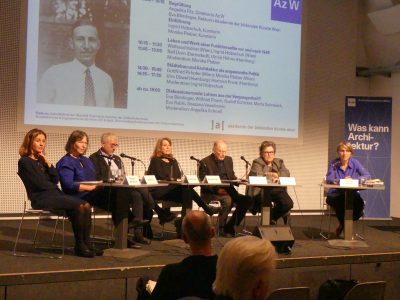
Snezana Veselinovic, Eva Rubin, Rudolf Schicker, Marta Schreieck, Wilfried Posch, Eva Blimlinger, Angelika Schnell
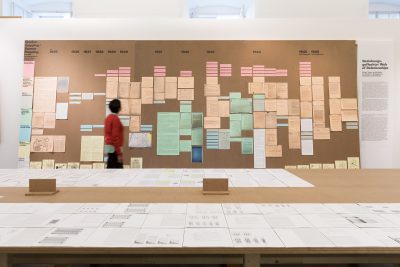
In cooperation with the Academy of Fine Art Vienna: A study of original source documents from the many years in which Roland Rainer was influential, held in German, Austrian and Polish archives. This research was necessitated by the unclarified role he played during the Nazi era. The first findings of this extensive architectural research in Austria and abroad was presented and discussed in 2018 at SammlungsLab #3, Roland Rainer. (Un)Disputed. New Findings on the Work (1936–1963).
A full day international symposium on 20.10.2018 shed light on Rainer’s life and work, going beyond the borders of Austria into the European context. The international experts placed Rainer’s impact during the Nazi period as well as after 1945 in a broader regional and transnational context. Equally themetised were the leeway for manoeuvre and the socio-political responsibility of Rainer, and so by proxy of the architect’s profession.
Project team: Ingrid Holzschuh, Waltraud Indrist, Monika Platzer
The project was supported by: Zukunftsfond der Republik Österreich, Bundeskammer der ZiviltechnikerInnen, Wien Holding GmbH, Kammer der ZiviltechnikerInnen, ArchitektInnen & IngenieurInnen für Wien, Lower Austria & Burgenland.
2016–2018: Processing the Estate
Günther Domenig (1934–2012)
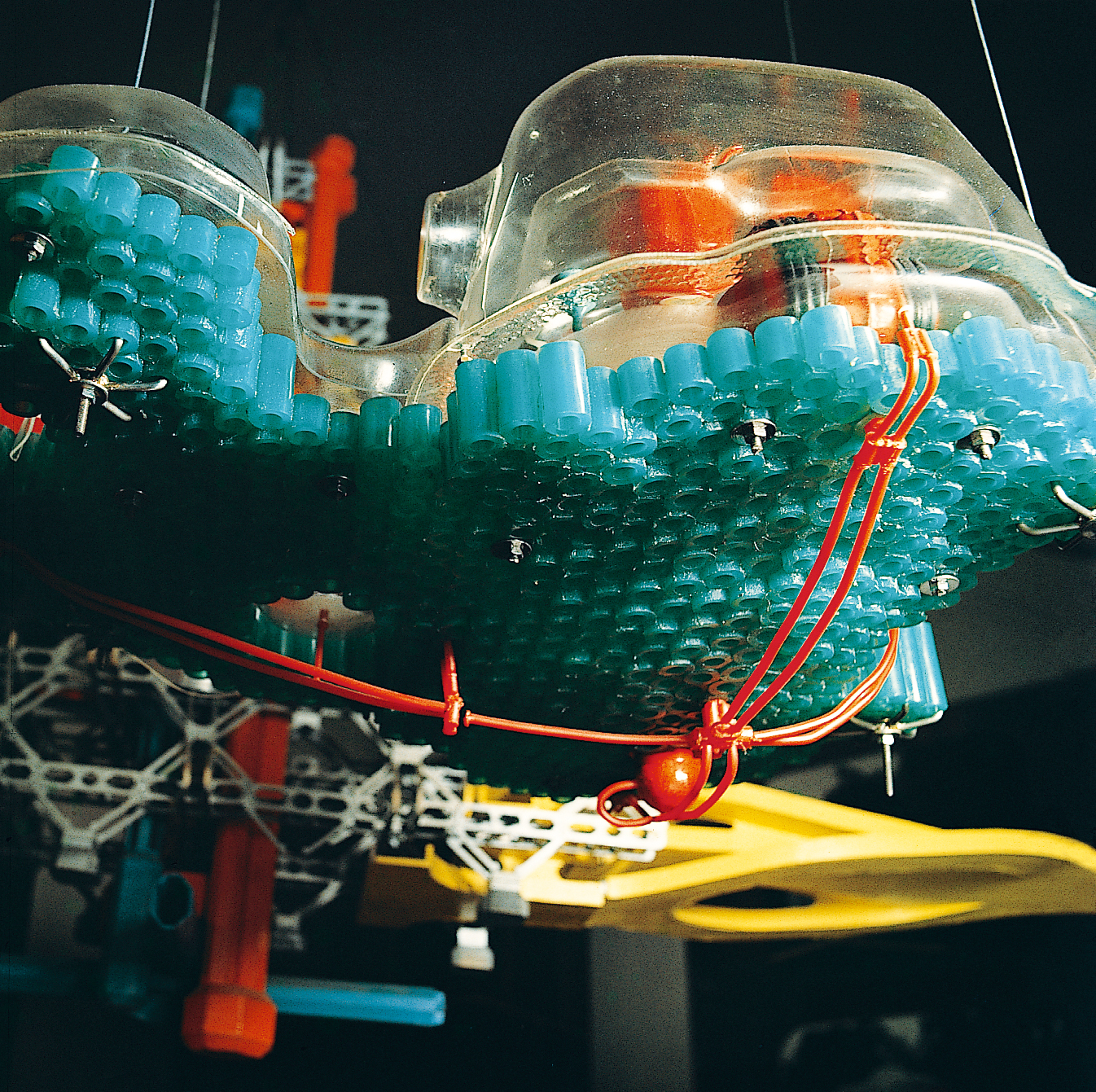
Günther Domenig was one of the protagonists of the Graz architecture scene, which caused a furore internationally known under the name of “Grazer Schule”.
Project team: Monika Kus (2016), Christoph Freyer (2017), Katrin Stingl (seit 2016)
The extensive holdings were transferred in 2014 from the office Domenig & Wallner ZT, the last place where Günther Domenig worked, to the Az W and are at present being categorised scientifically. From 1964 to 1975 Domenig worked with Eilfried Huth (*1930), whose architectural archive is also in the Az W. This makes it possible to bring together all the projects by the office partnership Domenig Huth and to document them completely. Today their buildings and above all their visionary competition entries are considered master works in the history of Austrian architecture. For the mega-structure project spanning over the town of Ragnitz, which was shown in 1966 in the context of the exhibition “Urban Fiction”, they were awarded the Grand Prix d’Urbanisme et d’Architecture in Cannes in 1969, which laid the foundation for their international career.
2013–2014 Teaching
Seminar “Object based research in the Az W Collection. The estate of Eugen Wörle”
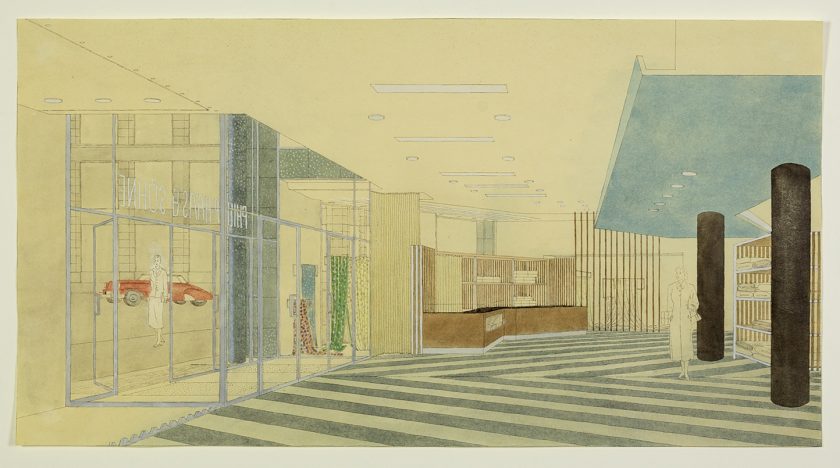
In cooperation with the Lehrstuhl für Denkmalpflege und Bauen im Bestand, TU Vienna
Lecturers: Nott Caviezel, Birgit Knauer, Monika Platzer
This seminar was intended to offer students an insight into the practice of architectural research and archive work while at the same time conveying the basis of scholarly work (structuring a written work both methodically and in terms of its content). Dealing with archival material from the area of Austrian architecture of the 20th century was also one of the focal points.
2013 Research
The scholarly processing of the NS Archive of Klaus Steiner was successfully completed through the research project “Bauen im Nationalsozialismus am Beispiel Wien”(Building in National Socialism, using Vienna as an example).
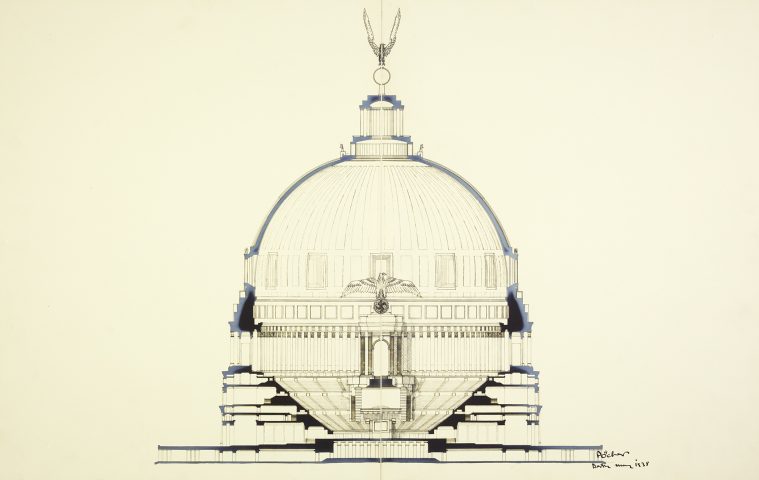
Lecturers: Ingrid Holzschuh
The extensive archive of Klaus Steiner was integrated in the database of the Az W Collection. This means that the entire archive material on the history of architecture in Vienna under National Socialism is now accessible to the public. Funded by the Zukunftsfonds of the Republic of Austria.
2012–2013 Teaching
Seminar at the Institute for Art History and European Ethnology, Vienna University: “Archival based research on the history of 20th century architecture”
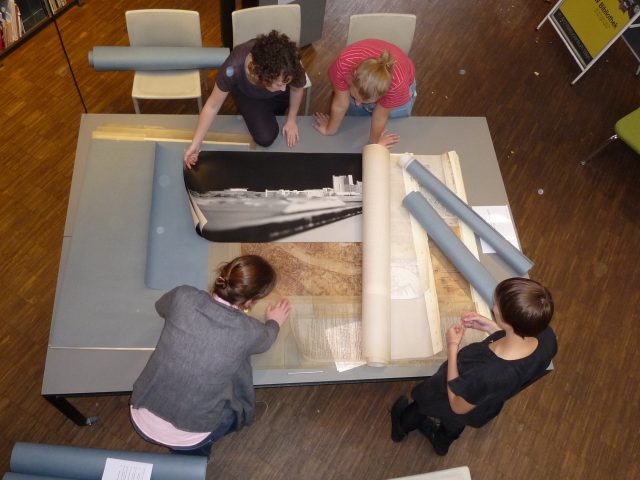
Lecturers: Ingrid Holzschuh, Monika Platzer
Using the example of various architecture projects from the Az W Collection the students were trained in dealing with primary sources in the archive. The existing source material was researched, examined and analysed with regard to the architectural scope of the project.
2010 Teaching
Cataloguing and Processing the Estate of Johann Staber
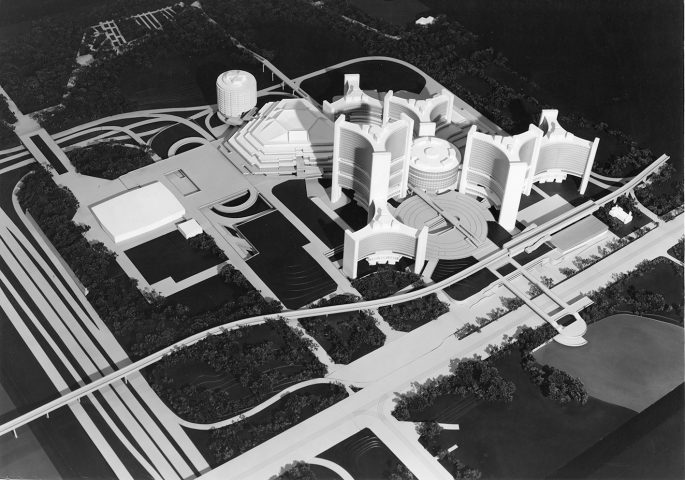
In cooperation with the TU Vienna/Institute for Art History, Building Research and Monument Conservation. In the framework of a seminar the architectural bequest of Johann Staber (1928–2005), who built the UNO City Vienna, was inventoried and processed by students.
Lecturers: Caroline Jäger-Klein, Sabine Plakolm
Supervision Az W: Katrin Stingl
2009–2010 Teaching
Cataloguing and Processing the Estate of Kaym & Hetmanek
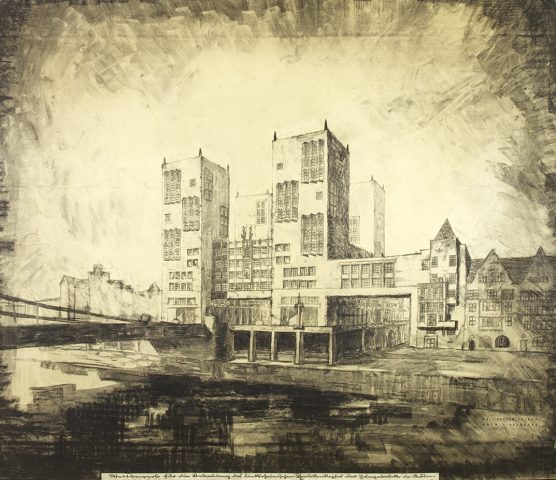
In cooperation with the TU Vienna/Institute for Art History, Building Research and Monument Conservation
Lecturers: Caroline Jäger-Klein, Sabine Plakolm
Supervision Az W: Monika Platzer, Katrin Stingl
Diploma Theses, Master Degree Theses, Doctoral Theses, Studies