From 1805 onwards, planning begins for a polytechnic institute modeled on the French École Polytechnique (the Napoleonic Wars create an increased demand for engineers).
Imperial and Royal Polytechnic Institute 1815–1875
1815
Founding of the Imperial and Royal Polytechnic Institute of Vienna with a military and a specialist trade school. There is a technical and a commercial department, but no standardized degree.
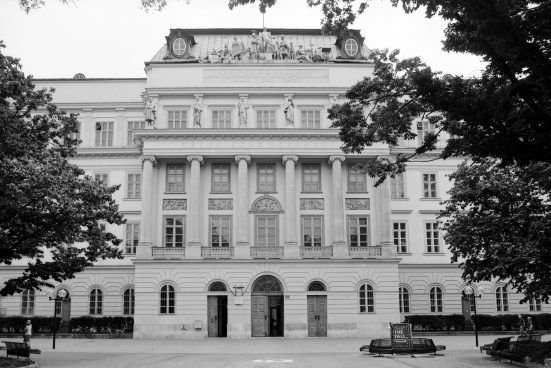
Officially opened on November 6, 1815, the building on Karlsplatz is constructed according to plans by Josef Schemerl von Leythenbach and Andreas Fischer (reliefs by Josef Klieber). The structure subsequently receives numerous additions and remains the main building of the Technical University of Vienna (TU Wien) to this day.
1847–1857
The Academy of Sciences is also located here.
1865
Reform (including a distinction between regular and non-degree students; there are five departments: General Department, School of Engineering [road and hydraulic engineering], School of Construction [structural engineering], School of Mechanical Engineering [mechanical engineering], and the Chemical-Technical School [technical chemistry]).
Introduction of the so-called “Strict Examination,” which is intended to be considered a diploma (but is very rarely taken).
Imperial and Royal Technical University 1875–1918
1875
Introduction of the First and Second State Examinations—however, no certificate of completion or diploma (officially, no engineering title).
1901
Introduction of the doctoral viva regulations, possibility of doctoral studies (first doctoral candidates in 1902), equal status with universities.
1913/14
Women are permitted to enroll as non-degree students.
1917
Graduates of the Second State Examination are permitted to use the professional title Ingenieur (Engineer).
Technical University 1919–1945
1919/20
Women are permitted to enroll as regular students.
1928
The technical colleges are renamed faculties.
1938
Non-Aryan professors and students are excluded; the title Dipl.-Ing. (instead of the previous Ing.) or Dr.-Ing. is introduced, following the German model.
The Second State Examination is replaced by a Diploma Examination.
The five faculties are merged into three – the Faculty of Civil Engineering now comprises architecture, civil engineering, and surveying.
Technische Hochschule 1945–1975
Five faculties are re-established; however, the title Dipl.-Ing. is retained and becomes an academic degree (previously a professional title) with the 1966 Higher Education Act (AHStG).
Technical University of Vienna from 1975 onwards
1975
Renamed Technical University of Vienna (TU Wien) by the 1975 University Organization Act (UOG) – Restructuring of the five faculties into: Spatial Planning, Architecture, Civil Engineering, Mechanical Engineering, and Electrical Engineering.
The professorial body becomes an Academic Senate.
1988
The TU Wien gains partial legal capacity.
1990
The TU Wien celebrates its 175th anniversary.
1993
With the second University Organization Act (UOG) of 1993, Austrian universities receive a new institutional framework, primarily intended to ensure greater autonomy.
The university is headed by the Rector and a newly constituted Senate; they are supported by the Vice-Rectors and a University Advisory Board.
1999
The new university organization comes into effect on January 1.
Literature
Juliane Mikoletzky, “Geschichtliche Entwicklung,” in Veröffentlichungen des Universitätsarchivs der Technischen Universität Wien, Issue 3, edited by the Technische Universität Wien (Vienna: Universitätsarchiv der TU Wien, 1997), p. 5 ff.
Author: Ursula Prokop