1692
The Academy is founded on the initiative of Peter Strudel (1660–1714), modeled after the Accademia di San Luca in Rome (1593) and the Paris Académie Royale (1648).
1714
Upon the death of Peter Strudel, the Academy’s activities cease indefinitely.
1726
On January 20, Emperor Charles VI appoints the Frenchman Jacob van Schuppen as the new Prefect and Director of the Academy. His duties are defined according to the statutes of the Paris Académie Royale: the cultivation and teaching of painting, sculpture, architecture, and engraving.
1726–1742
The growth of the Academy necessitates its expansion into various quarters.
1751
Statutes of Maria Theresa: The administration is the responsibility of the Protector; the staff consists of the rector, assessors, a secretary, and professors; an archive is founded.
1766
Jakob Matthias Schmutzer receives permission from Empress Maria Theresa to establish an Academy of Engraving, which subsequently enters into open competition with the old Court Academy.
1767
The first honorary memberships are awarded to Archduchesses Charlotte Karoline and Maria Anna.
1772
New organizational structure: At the instigation of Protector Kaunitz, all existing art schools are merged to form the K. k. freyen vereinigten Akademie der bildenden Künste (Imperial and Royal Free Unified Academy of Fine Arts).
1786
The Academy moves to the St.-Anna-Gebäude, Annagasse 3, Vienna 1.
1800
A new statute stipulates that the Academy is now both an art school and an art society. The rector is replaced by the praeses, who is subordinate to the imperial curator.
1812
New name: Akademie der vereinigten bildenden Künste (Academy of Unified Fine Arts); the Academy is now also the highest art authority.
1848
The Academy’s activities are restricted to teaching; the superior Imperial and Royal Ministry of Education is established.
1865
According to a new statute, the emperor appoints the professors; minutes of meetings are to be submitted; the Academy is headed by a president (elected for a three-year term).
1871
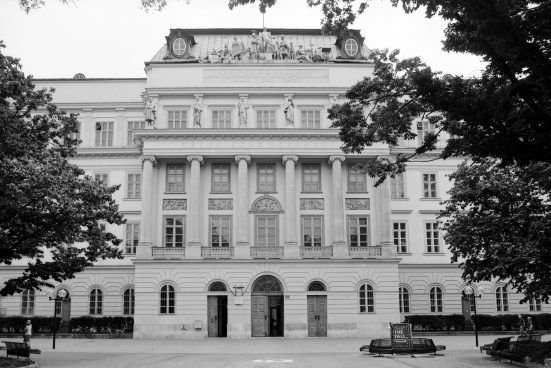
Approval is granted for the construction of a new Academy building in conjunction with the construction of the Ringstrasse. Based on the plans of Theophil Hansen (1813–1891, head of a special school for architecture at the Academy), construction begins on the new building on Kalkmarkt (today Schillerplatz) at a cost of 1,200,000 guilders. Construction lasts until 1876.
1872
Jubilee Statute of Emperor Franz Joseph I: Separation of the arts administration and the educational institution; management by the rector and the faculty.
1877
On April 1, the Imperial and Royal Academy of Fine Arts in Vienna is ceremonially opened with a historical art exhibition of selected works from its founding to the present day.
1920
The State Office approves the admission of women and girls to the Academy starting in the winter semester of 1920/21.
1938
Classes are interrupted for only a few days, but the Academy loses its autonomy.
1939–1944
Considerable restrictions on teaching activities.
1944
The Academy is placed under the authority of the Faculty of Philosophy, headed by Alexander Popp.
1945
On April 19, Herbert Boeckl assumes the duties of Rector, and on April 23, classes resume on a modest scale.
1955
New legal framework in the form of the Academy Organization Act; the Academy’s independence is reaffirmed, and the master schools are supplemented by a number of institutes.
1988
As the last Austrian university to do so, the Academy adopts an organizational structure, retaining the master school principle and its traditional name; a shared responsibility is transferred to the professors, other university lecturers, and students.
1992
As the oldest art academy in Central Europe, the Academy celebrates its 300th anniversary.
1996
The studio building (formerly the Federal Theatre’s scenery depot, built 1874–1877 according to plans by Gottfried Semper and Karl Hasenauer) is occupied by the master classes for painting and stage design after its revitalization by Carl Pruscha. The Studio for New Media and the Glyptothek are established.
1998
On October 1, the Academy of Fine Arts Vienna becomes a university, keeping its name. Adaptation to the new organizational law (KUOG) with the gradual implementation of the new organizational and academic regulations.
Literature
Hans Seiger/Sabine Plakolm-Forsthuber/Michael Lunardi (eds.), Im Reich der Kunst. Die Wiener Akademie der bildenden Künste und die faschistische Kunstpolitik (Vienna: Verlag für Gesellschaftskritik, 1990).
Walter Wagner, Die Geschichte der Akademie der bildenden Künste in Wien (Vienna: Rosenbaum 1967).
Author: Andreas Nierhaus