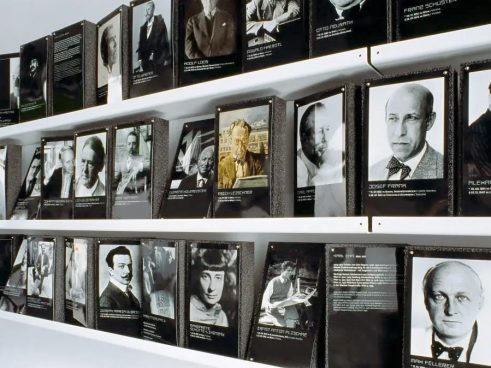
Primary Research Results
Through intensive and extensive research, it was possible to close important research gaps and make fundamental data available for in-depth analyses and further research.
Around one-third of the architects appearing in the Encyclopedia were documented for the first time, including those who were highly successful during their lifetimes and whose works remain significant to Vienna’s cityscape today.
For the first time, architects whose information is extremely limited in contemporary encyclopedias and reference works, as well as in more recent encyclopedias, are recorded with complete data. Incorrect attributions have been clarified, as have various misunderstandings arising from similar names or mix-ups. Incorrect data, or data presented differently in various sources, has been corrected. For the first time, the architectural authorship of approximately 900 projects, particularly residential and commercial buildings and villas, has been established.
The meticulously researched biographies and descriptions of the respective architects’ working methods not only reveal architectural-historical connections but also offer, at least in outline, a first-ever analysis of relevant facts concerning socio-political, cultural-historical, and urban planning contexts.
Secondary Research Findings
Due to the novel quality of the Encyclopedia of Architects, a gradual intensification of international scholarly exchange and cooperation (e.g., contact with scholars in the USA, France, Germany, and Switzerland) proved necessary. In particular, contacts were established with scholars from the former “crown lands,” i.e., the countries of Eastern Europe, resulting in several intensive collaborations. Fruitful exchanges likewise arose with domestic institutions, such as the Federal Monuments Office, in addressing specific questions.
The thorough processing of the material and the clear presentation of the individual entries have made the Encyclopedia of Architects accessible to a broad audience. On the one hand, it is used by academics and students in the field, and on the other hand, it is also used across disciplines by academics and students from other domains—such as history and cultural studies. Furthermore, it is also used by architects, preservationists, and interested individuals.
Numerous responses from Austria and abroad demonstrate that the Encyclopedia has now achieved a high level of recognition internationally and has been extremely well received.
The great interest in the Encyclopedia and its positive international reception have been instrumental in unlocking new sources that were previously unknown or difficult to access, thus enabling a valuable exchange between research and praxis. For example, new and helpful information has been received from relatives still living—scattered around the world. Conversely, individuals researching a specific work by an architect, or interested in the subject in other professional contexts, have repeatedly provided valuable supplementary information.
With the publication and continuous expansion of the Encyclopedia of Architects, the Architekturzentrum Wien’s profile as a national and international resource for questions concerning architectural history and theory has been strengthened and broadened.