
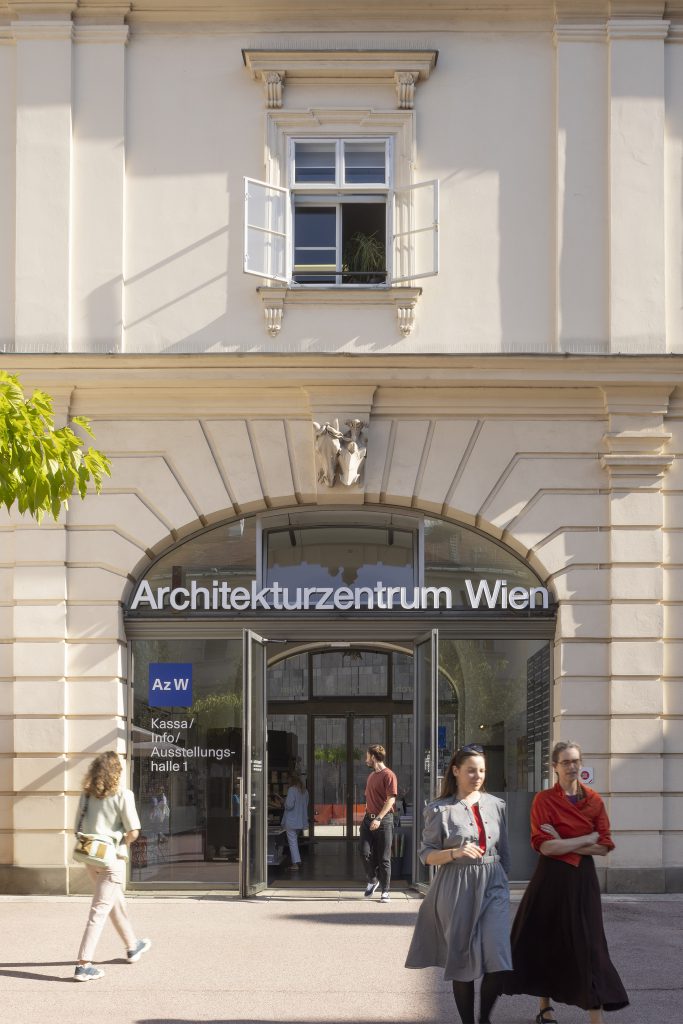
Architekturzentrum Wien
© photograph: Lisa Rastl
What does architecture want? The Architekturzentrum Wien is launching its annual programme for 2026 with this question. The exhibition ‘Global — Neutral’ presents architecture as part of a shared, albeit conflict-ridden world that has been restructured since 1945. It draws on the extensive holdings of the Az W Collection, spanning from Baghdad and Tehran to New Delhi and Kathmandu, to São Tomé. A second major exhibition, ‘Temporary. Structures of Necessity’, sheds light on those often overlooked and indispensable buildings that keep our cities running from day to day.
From April 2026, the exhibition Global — Neutral goes on the trail of Austrian architects working in Africa and Asia between 1955 and 1989. Shaped by the nation’s self-proclaimed image as a neutral state without a colonial past, they place Austria’s ostensibly marginal position firmly at the centre of the global context. Plans, photographs, and models from the Az W Collection showcase completed projects and unrealised plans by around 25 Austrian architects, including Hans Hollein, Eva Mang-Frimmel and Karl Mang, Roland Rainer, and Anton Schweighofer. With ‘Global — Neutral,’ the Az W continues its work of making the social dimension of architectural history visible.
From autumn 2026 Temporary. Structures of Necessity focuses the limelight on everyday utility buildings — the majority of which usually go unnoticed. A rapidly changing layer of makeshift and provisional structures is instrumental to building, maintenance, orientation and preservation. The exhibition asks what we can learn from these flexible and resource-saving structures. Temporary construction is presented here as a laboratory for architecture that responds directly to social and environmental changes.
The Az W’s presence also extends beyond Vienna, with two successful exhibitions on tour in Austria in 2026. Toourism is already entering its second year on tour, and from March it will be at the House of Architecture in Munich to show just how much our vacation dreams shape the built environment. Suburbia. Built Dreams — The Future Single-Family House engages with the ongoing popularity of the single-family home despite the climate crisis, consumption of land and rising construction costs — on show at both the Offenes Haus Oberwart (Burgenland) and at the Museum Wattens (Tyrol).
The permanent exhibition on Austrian architecture of the 20th and 21st centuries, Hot Questions — Cold Storage, continues to be a favourite with the public, with its seven Hot Questions on ways of living, capital, tools, identity, the environment, infrastructure and participation. During the Lange Nacht der Forschung (Long Night of Research) at the end of April, it manifests as a Jukebox of Questions.
As always, the exhibition is accompanied by an extensive program of events and educational activities: discussions, symposiums and hands-on workshops for all ages and all of the senses, as well as excursions tailored for international groups, events for schools, and inclusive formats. The Architecture.Film.Sommer — now one of Vienna’s most successful summer film festivals — is dedicated to the theme Building Democracy.
The Az W Collection Goes Online!
The launch of the Az W Collection online represents a major milestone in 2026. As the only architecture museum in Austria, the Az W has the most comprehensive collection of Austrian architecture of the 20th and 21st centuries anywhere. After several years of preparation, the databases of objects, photographic archives and encyclopaedia of architects have all been combined in one unique online tool. With the Az W Collection online Austrian architectural history becomes accessible worldwide around the clock, providing both researchers and the general public with clear search options and useful insights.
In total, around 60,000 documents — plans, sketches, photographs and photographs of models, as well as the Achleitner Archive and its legendary collection of index cards — will all be accessible in digital form. The platform is being expanded on an ongoing basis and augmented with additional holdings.
The Online Collection promotes women. Together with the Margarete Schütte-Lihotzky Center, the Az W has launched the research project Pioneering Female Architects in Vienna, the results of which are to be incorporated into the Az W Collection online. More than 200 women had already attended Austrian institutions of higher education prior to 1938, and one of our long-term research objectives is to provide visibility for female architects.
Collaboration on research is continuing to expand in 2026. An innovative network for research, teaching, and education is being developed for the Research Center of the Az W Collection. To this end, the Az W is working in collaboration with the Art History research department at TU Wien. The aim is to study Austrian architectural history of the 20th and 21st centuries using original sources, also providing students with practical insights into museum and academic work, and for their theses and dissertations.
Director of the Az W
After ten successful years, for health reasons Angelika Fitz is stepping down from her position as Director of the Az W at the end of 2026. Hannes Swoboda, President of the
Az W, expressed his sorrow at this decision and his gratitude to Angelika Fitz for her outstanding work: “The Az W has become one of the most influential institutions for architecture and building culture worldwide. At the same time, with its broad programme, a younger audience and close cooperation with stakeholders and public authorities, it has become a key local player.”
Angelika Fitz expressed her delight that, “together with the team, we have been able to expand the communication of architecture to include environmental, planetary and feminist perspectives. We can hand over a well-established institution, in both an international and a national context, one that is among the most proactive architecture museums in the world.”
So, too, Executive Director Karin Lux would have liked to continue their collaboration and hopes that such a successful course will be maintained. In light of the upcoming challenges, she is appealing to public partners not to add to the burden of the already gravely underfunded Az W.
The new Director of the Az W is to be selected from 45 applicants of various nationalities in the coming spring.