
1. Introduction
Purpose of the Child Protection Policy
The Architekturzentrum Wien regards itself as an extended educational space, the aim of which is to encourage and empower people to play a proactive role in shaping future developments. This applies in particular to children and young people. We seek to broaden and awaken an understanding of architecture and all planned built environments, to foster a sense of discovery within the urban landscape, and thereby to create an awareness of the designed environment, with a view to nurturing the responsible citizens and clients of tomorrow.
In doing so, it is important to us to offer our young visitors a safe space for this engagement. We are committed to ensuring the welfare of children and young people, as well as their protection from mistreatment and all forms of abuse within our organisation. We adopt a vigilant approach towards children and young people and their needs while safeguarding their rights. We take measures to prevent experiences of violence and boundary violations in our physical and digital spaces, to promote safe practices among our staff in situations where children’s welfare might be at risk, and to raise awareness of the risk of experiencing violence that young people face.
Defining Violence Against Children and Young People
There are various forms of violence. The forms of violence of particular relevance to the activities of the Architekturzentrum Wien are:
• Physical violence: Forms of abuse directed against the body, e.g. pushing, kicking, restraining, hitting etc.
• Psychological violence: Forms of violence that target self-esteem, integrity and dignity, e.g. disregard, mockery, verbal abuse, intimidation, humiliation etc.
• Sexual violence or sexualised violence: The abuse of young people to satisfy one’s own sexual, emotional or social needs. Sexual violence refers to attempted and/or completed sexual acts, but also to sexual acts without direct physical contact — such as the production of pornographic material.
• Neglect: Inadequate care, failure to provide support, and the neglect or withholding of physical and psychological support and care.
• Peer violence among children and young people and bullying: Physical, sexualised and psychological violence, as well as relationship-based violence (social exclusion from groups) and systematic aggression/violence towards one or more children or young people.
• Media-mediated violence/cyberviolence: All forms of violence in the digital space resulting from the misuse of communication tools such as WhatsApp, TikTok or Instagram, such as cyberbullying, stalking etc.
• Institutional violence: Violence and abuse of power by staff members of an institution, or the condoning of violence by external individuals, residents, clients, visitors etc.
Violence and assaults can occur between adults, between children/young people, or between adults and children/young people. In this Child Protection Policy, the main focus is on the protection of children and young people within the context of the activities of the Architekturzentrum Wien.
To ensure clear differentation, the three key terms are explained below:
• Boundary violations: Behaviours through which the personal boundaries of others are crossed (sometimes out of ignorance or carelessness) verbally, non-verbally or physically. These behaviours could subsequently lead to violence. Examples include: derogatory remarks, disregard for the right to one’s own self-image, flirtatious behaviour etc.
• Assaults: Serious boundary violations intended to assert one’s own interests at the expense of others. Examples include: psychologically humiliating behaviour; (deliberate, forceful) shoving or pulling; sexualised remarks and gestures; failure to put a stop to bullying etc.
• Violence (criminal): Violence is a criminal offense when it involves harassment, coercion, torment, bodily harm, (serious) sexual abuse, severe neglect, rape, child prostitution, stalking, making dangerous threats, sharing nude photographs or videos, and child pornography.
The Legal Framework*
The rights of children and young people, including their protection from all forms of violence, are enshrined in (various) conventions and laws at global, national and regional levels; these rights are enforced in particular through legislation on the protection of children and young people from violence.
The UN Convention on the Rights of the Child* and its three Optional Protocols form the overarching framework. Its four fundamental principles are self-evident to us and form the basis for our actions:
• The right to equal treatment
• The best interests of the child
• The right to life and personal development
• Respect for the child’s views
2. Risk Analysis
The Architekturzentrum Wien carried out an initial risk analysis from February to December 2024, which served as the starting point for drawing up the Child Protection Policy. Staff participation played an important role throughout the various meetings and phases. In a second step, during a workshop on the Child Protection Policy held on 3 April 2025 and facilitated by Lisa Dungl from Die Möwe, all staff members from the Education Department undertook an analysis of the organisation’s processes, scrutinising all formats and series of events aimed at private groups of children and school classes for potential risks.
This risk analysis is not a process with an end, but rather a starting point and a tool for an ongoing process of reflection. In the evaluation and updating of the Child Protection Policy, existing risks and the appropriate measures must also be regularly reviewed.
3. PREVENTATIVE MEASURES
Enabling the Participation of Children and Young People
We value the perspectives of children and young people on the built environment, and their opinions as users are important to us.
For us, participation is a guiding principle in terms of both methodical approach and content. On the one hand, we aim to give participants as much scope and as many opportunities for creative input as possible while we also seek to highlight opportunities for participation in urban planning processes, such as public consultation procedures, building groups or urban gardening initiatives etc.
Code of Conduct for Staff
• Ensure that the workplace is free from psychological and physical violence.
• Help create a safe, supportive and encouraging environment for children and young people.
• Take the views and concerns of children and young people seriously and support their personal development.
• Treat all children and young people with respect.
• Follow the ‘two-adult rule’, i.e. planning situations and activities involving children, young people and vulnerable groups so that several people are always within sight and earshot, and to avoid one-to-one situations.
• When taking photographs, filming or reporting, to respect their dignity and the need to safeguard children and young people; in particular, to handle personal data with care and to require the same of third parties who receive information about children and young people from our organisation.
• Take responsibility for protecting children and young people from abuse and report any suspected cases immediately to the Child Protection Officer.
The Child Protection Officer at the Architekturzentrum Wien
In accordance with the dual-control principle, the child protection team consists of a Child Protection Officer and a deputy.
Contact:
Email: wuebben@azw.at
Tel.: +43 (1) 522 31 15-29
or
Email: office@azw.at
Tel.: +43 (1) 522 3115
Child Protection Officer: Anne Wübben
Deputy Child Protection Officer: Daniela Zistler
Human Resources
• All staff members are carefully selected and vetted prior to recruitment. New staff members who come into direct contact with children and young people must, in addition to the standard criminal record check, provide a criminal record check specifically for ‘child and youth welfare’ (the costs incurred are borne by the Az W).
• We address both the Az W child protection policy and our stance on violence against children and young people at job interviews.
Awareness-raising and Further Training
The Az W ensures that all staff members who work with children and young people treat them with respect. Furthermore, all staff members should have a basic understanding of violence prevention, including the prevention of sexual violence, and be able to recognise signs of abuse.
To this end, regular meetings are held to discuss any issues that may arise, including how to convey certain topics in a particularly clear and understandable way, as well as whether there are any concerns regarding the children. We only see the children for extended periods during the summer academies, so it is difficult to spot signs of abuse from the outside. Nevertheless, this is a topic covered at these regular meetings and refreshed at regular intervals in a team workshop.
Guidelines for Public Relations, Media Relations and Data Protection
• Children and young people have a right to privacy.
• The Az W is committed to exercising due care when recording and publishing media content in order to protect the identity of children and young people, and to safeguard their integrity. Consent is obtained from the individuals depicted before any image, audio and/or video material is produced or published. For children under the age of 14, the written consent of their legal guardians is also required.
• During the production of image, audio and/or video material, we ensure that participants are informed about the purpose of the recordings in a manner appropriate to their age and that they consent to their use.
• When recordings are made at (large-scale) events where it is not possible to obtain consent, such recordings are only be made from a considerable distance so that individuals cannot be recognised.
• Where personal data relating to children is collected, it will be processed in accordance with the General Data Protection Regulations (GDPR).
Approach to Sex Education
Those who lack the language to discuss sexuality usually also lack the language to seek help when it comes to sexual violence. Accordingly, sexual education forms the basis for the prevention of sexual violence.
• All young people are sexual beings from birth, regardless of their gender.
• Sexuality is a natural and valuable part of human development.
• Sexuality, in its various facets and forms, is a fundamental need, and part of every person’s identity.
• Sexual learning takes place in many situations, not just when sexual aspects can be perceived.
• The sexual development of children and young people must always be taken into account and considered in everyday educational practice.
• Within our teams, topics relating to sexuality, sexual violence and sexual boundary violations can be discussed without fear.
4. Site-Specific Details
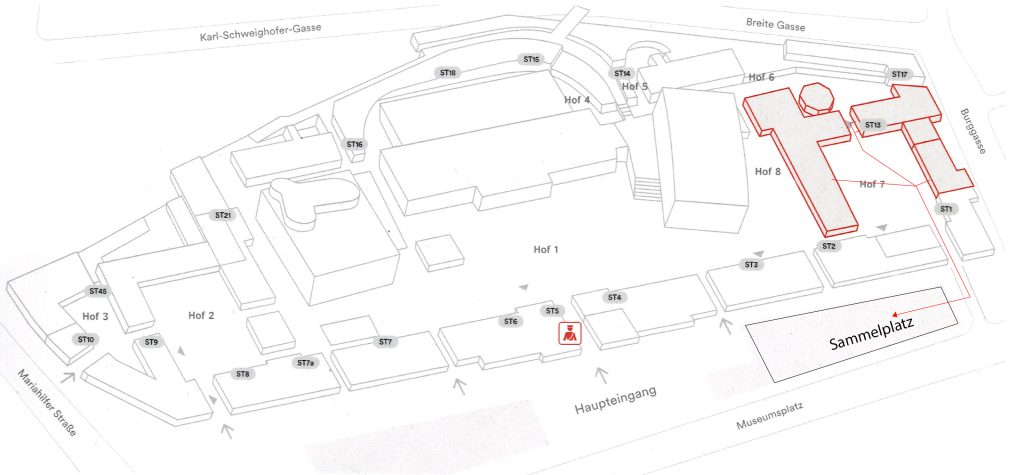
Evacuation plan with assembly point
Procedure if a Child is Not Collected
If a child is not collected after a workshop, the parents will be informed immediately (telephone numbers are obtained in advance). The child will remain for at least 30 minutes with two facilitators in the room where they are due to be collected. Beyond this period, and in consultation with the child and their parents, they will be asked to wait in the office of the Architekturzentrum Wien so that we can comply with the ‘two-adult rule’.
Important Telephone Numbers
Parents’ telephone numbers are requested in advance.
Reception (staffed on weekdays from 9:00–17:00): +43 (1) 522 3115
Head of Education, Anne Wübben (at weekends): +43 (699) 121 75 142
Security control centre at the MQ: +43 (1) 523 5881 1700
Fire brigade: 122
Facilitators are Familiar with the In-house Facilities:
– The first-aid kit is located in the workshop room
– The fuse box is located in server room 1
– Report fires and technical faults immediately to the ticket office and the MQ Security Centre
Arrangements for Summer Academy Excursions
The Architekturzentrum Wien organises excursions within the city. The guides are responsible for supervising participants during these excursions. When walking on the road, all participants must walk in pairs and must not stray from the group. At the playground, they are free to move about, but must be aware of the meeting point, where a guide is always present.
Contingency Plan for Excursions
Children should save the facilitators’ mobile numbers in advance, for use if a child loses contact with the group.
5. Incident Management
The Architekturzentrum Wien has created a framework that allows space for concerns and complaints of all kinds, including those relating to all forms of boundary violations, assaults and violence. To this end, the Az W promotes a culture of trust, transparency and respect in dealing with mistakes, conflicts and communication that is practised, supported and continuously reflected upon at all levels.
Everybody working in the education and outreach department of the Architekturzentrum Wien is familiar with, and has access to, the relevant procedures within the child protection system, as well as the corresponding guidelines for action, and they are aware of the relevant internal and external points of contact (child protection officers and child protection centres).
The Handling of Concerns, Complaints, Issues and Suspected Cases
Complaints may, in principle, be lodged by anyone who comes into personal contact with the Architekturzentrum Wien (children, young people, accompanying adults and staff) — all Az W staff can and should accept complaints and forward them to the relevant person. The aim is to create an environment where critical feedback is also heard.
Complaints by email can be sent to the Child Protection Officer, Anne Wübben (wuebben@azw.at) or to the general office email address (office@azw.at). In cases concerning child protection, the Child Protection Officer must be informed immediately. The Architekturzentrum Wien investigates every suspicion of violence and every complaint without delay (initial assessment by the Child Protection Officer within 48 hours of a matter’s coming to light).
Reports, concerns and complaints from children (and their adult carers) are taken seriously without exception. They are received with a calm, sensitive and respectful attitude — neither trivialising nor dramatising the situation.
6. Evaluation & Further Development
The Child Protection Policy is not the product of a completed process, but rather a basis for ongoing review. The Child Protection Team is responsible for monitoring its implementation and evaluating the effectiveness of the measures, in regular consultation with the management. The Child Protection Team is available throughout the year to receive feedback from staff. To further develop and update the Child Protection Policy, existing risks and the measures derived from them are reviewed annually.
• Documentation of all reports
• Monitoring the implementation of the Child Protection Policy within the organisation
• Evaluation and regular review of the Child Protection Policy